
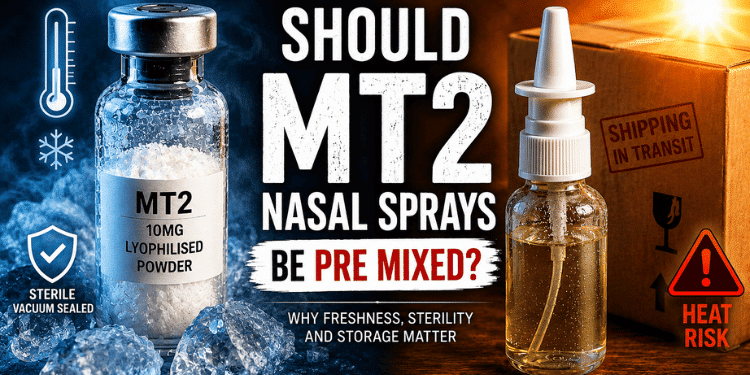
MT2 nasal sprays are sold in two main formats: as prepared liquids and as kits containing freeze-dried Melanotan 2, water and an empty nasal bottle. Supplying these components separately gives the customer a known preparation date, but it does not prove that the resulting spray is sterile, clinically effective or safe.
This guide explains what can reasonably be said about freeze-dried peptides, liquid stability, transport, microbiological quality and nasal delivery. It also identifies the important questions that available evidence cannot answer.
Should MT2 Nasal Spray Arrive Premixed?
There is no published product-specific study that allows every premixed MT2 nasal spray to be classified as stable or unstable.
There is also no validated universal shelf life showing exactly how long Melanotan 2 remains unchanged in every liquid formulation, bottle and storage condition.
The strongest practical argument for supplying the components separately is therefore not that all premixed products are necessarily degraded. It is that the customer can know when the liquid was prepared.
With a premixed product, important information may be unavailable:
- When the liquid was prepared
- Which liquid formulation was used
- How it was stored before dispatch
- What temperatures it encountered during transport
- Whether its chemical and microbiological stability was tested
- Whether the bottle delivers a consistent amount with each spray
A separately supplied kit removes some uncertainty about the age of the prepared liquid. It does not remove every quality or safety uncertainty associated with an unlicensed nasal product.
What Does Freeze-Dried Mean?
Freeze-drying is also called lyophilisation. It is a manufacturing process that removes water from a frozen material under reduced pressure.
Lyophilisation is commonly used in pharmaceutical and biotechnology manufacturing to support the stability of proteins and peptides that may be less stable in liquid form.[1]
However, freeze-drying does not automatically guarantee a particular shelf life or product quality. The final stability of a freeze-dried peptide depends on factors including:
- The peptide and its chemical properties
- The formulation and any added excipients
- Residual moisture
- The freeze-drying process
- The vial and closure system
- Exposure to heat, moisture and light
- Manufacturing and storage conditions
The fact that a substance appears as a dry powder is not, by itself, proof of its identity, content, purity or stability.
What Changes After a Peptide Is Mixed?
Adding water changes a dry peptide into a liquid formulation. Once in solution, a peptide can be exposed to different chemical and physical processes, potentially including hydrolysis, oxidation, aggregation or adsorption onto the container.
Whether these processes occur, and how quickly, depends on the particular formulation and storage conditions.
Relevant factors can include:
- Temperature
- Light exposure
- Solution pH
- Peptide concentration
- The type of water or solvent used
- Preservatives and other ingredients
- The bottle and pump materials
- Repeated opening and use
- Microbial contamination
This is why a specific storage period should be supported by product-specific stability testing. It should not be guessed from a general statement about peptides.
Does Liquid MT2 Immediately Begin Losing Potency?
It is too simplistic to say that a peptide begins losing meaningful potency immediately after water is added.
Chemical reactions may begin in a liquid environment, but that does not reveal:
- Whether measurable degradation occurs
- How quickly it occurs
- Whether it affects the delivered amount
- When the product would fall outside an acceptable specification
Answering those questions requires a validated stability study using the actual formulation, concentration, container, pump and intended storage conditions.
Without this evidence, claims such as “stable for 30 days”, “safe for three months” or “degraded after delivery” cannot be confirmed reliably.
What About Temperature During Delivery?
Transport can expose nasal products to changes in temperature and orientation. The effect of those conditions must be assessed rather than assumed.
FDA guidance for regulated nasal-spray products recommends temperature-cycling studies to examine how shipping and handling conditions may affect characteristics including appearance, assay, spray consistency, container integrity and pump function.[2]
This guidance does not prove that every premixed MT2 product will degrade during ordinary delivery. It demonstrates why manufacturers of regulated nasal products are expected to test the effect of temperature variation.
Questions that a premixed-product supplier should be able to answer include:
- What storage conditions were evaluated?
- Was the complete bottled formulation tested?
- Was temperature cycling performed?
- Was potency measured throughout the claimed shelf life?
- Was the pump tested throughout the intended period of use?
- Was microbiological quality assessed?
If no supporting study is available, storage and shelf-life claims remain unverified.
Does Shaking Automatically Destroy Melanotan 2?
Claims that routine parcel movement will automatically destroy Melanotan 2 are not supported by product-specific evidence.
Physical stress can affect some protein and peptide formulations, but susceptibility varies between compounds and formulations. A small peptide should not automatically be treated as behaving identically to every larger therapeutic protein.
The relevant question is not whether the parcel moved. It is whether the finished formulation remained within its chemical, physical and microbiological specifications following realistic transport conditions.
That requires testing. It cannot be established from appearance alone.
Microbiological Quality of a Nasal Spray
Nasal products require careful microbiological control because the bottle may be used repeatedly and the nozzle can be exposed during use.
Not every regulated nasal spray is manufactured as a sterile product. The appropriate requirements depend on the formulation and product category. However, manufacturers still need evidence supporting microbial limits, preservative effectiveness where applicable, container performance and the intended period of use.[3]
Important considerations include:
- Microbial quality of the ingredients
- Manufacturing hygiene and process controls
- Whether a suitable preservative system is present
- Whether that preservative system has been tested
- The integrity of the bottle and pump
- Contamination during repeated use
- The supported in-use period
A clear liquid can still have microbiological or chemical problems. Appearance and smell cannot establish that a nasal formulation is suitable for use.
Does Separate Preparation Guarantee Sterility?
No. Supplying freeze-dried MT2, water and an empty nasal bottle separately does not guarantee that the prepared liquid will be sterile.
Even where one component is labelled as sterile, transferring liquid between containers can introduce contamination. The condition of the empty spray bottle, transfer equipment, surrounding environment and handling process also matter.
Home preparation is not equivalent to manufacturing a validated nasal product under controlled pharmaceutical conditions.
The most accurate advantage of separate components is narrower: the person preparing the spray knows when the liquid was made and can keep the second kit sealed until required.
That practical advantage should not be expanded into an unsupported claim of guaranteed safety or sterility.
Can a Premixed Product Be Properly Manufactured?
In principle, a liquid nasal product can be manufactured with appropriate controls and evidence.
A credible finished-product assessment would need to address more than the identity of the active ingredient. Depending on the product, relevant testing could include:
- Identity and assay
- Degradation products
- Solution pH
- Microbial limits
- Preservative effectiveness
- Container and closure integrity
- Spray-content uniformity
- Droplet-size distribution
- Pump performance
- In-use stability
- Transport and temperature stability
Therefore, the problem is not simply that a product is liquid. The problem is the absence of transparent evidence supporting the particular liquid formulation, its storage instructions and its claimed shelf life.
Does MT2 Work Reliably Through the Nose?
The published human Melanotan 2 studies commonly cited for pigmentation and sexual effects used subcutaneous administration.[4]
Those studies do not establish how much Melanotan 2 is absorbed from a nasal spray.
Reliable intranasal delivery depends on several factors, including:
- The formulation
- Peptide concentration
- Droplet size and spray pattern
- The amount delivered by the pump
- Contact time with the nasal lining
- Mucus clearance
- Degradation within the nasal environment
- Individual nasal conditions
We did not identify a controlled human pharmacokinetic study establishing the absorption, bioavailability or dose consistency of retail Melanotan 2 nasal sprays.
This means an injectable research result cannot be converted directly into a claim about the amount absorbed from a nasal product.
Why the Nasal Bottle Matters
A nasal spray is a combination of formulation and delivery device. The bottle is not merely a container.
Regulatory guidance for nasal products considers properties such as:
- The amount delivered by each actuation
- Variation between early and later sprays
- Priming and repriming requirements
- Spray pattern
- Droplet-size distribution
- Storage orientation
- Pump robustness
An empty spray bottle described as delivering a particular number of sprays does not, by itself, prove that each spray contains an equal amount of Melanotan 2.
Consistent delivery requires testing of the complete prepared formulation inside the actual device.
What Does Pure MT2 Supply?
Pure MT2 nasal kits are supplied as separate components. The Melanotan 2 remains in its freeze-dried form, while the water and empty nasal bottle are packaged separately.
The practical purpose of this format is to avoid supplying a liquid with an unknown preparation date. In the 20mg package, the contents are divided between two separately packaged 10mg kits, so the second vial and bottle can remain separate until required.
This format does not establish that the prepared spray is clinically approved, sterile or proven to deliver a predictable amount of Melanotan 2 through the nasal route.
Product components and preparation information are described on our mixing-instructions page. That information should not be interpreted as individual medical advice.
What Can Laboratory Testing Establish?
Pure MT2 publishes its available independent laboratory analysis.
The document reports that the submitted sample was identified as Melanotan II, with measured content of 9.97mg and reported purity of 99%.
These findings apply only to the sample identified by laboratory order number 100011931. The report does not establish:
- The stability of Melanotan 2 after mixing
- A shelf life for a prepared nasal spray
- Microbiological quality of the prepared liquid
- Sterility
- Preservative effectiveness
- Consistency of the nasal pump
- Absorption through the nasal lining
- Clinical safety or effectiveness
- The composition of a different sample, lot or batch
A laboratory purity result should not be presented as evidence that a finished nasal spray has been validated.
UK Regulatory Position
Melanotan 2 is not a licensed medicine in the United Kingdom.
The UK Government has previously stated that no Melanotan product holds UK marketing authorisation and that Melanotan products are subject to medicines regulation.[5]
This applies regardless of whether the product is supplied as a powder, injection kit or nasal spray.
A separate-component format does not change the regulatory status of Melanotan 2 or make it an approved nasal medicine.
Questions to Ask About Any Nasal Product
Rather than relying on the words “premixed”, “fresh” or “lab tested”, useful questions include:
- Is the actual formulation disclosed?
- Is the preparation date known?
- Is there product-specific stability evidence?
- Is the claimed storage period supported by testing?
- Has microbiological quality been assessed?
- Has preservative effectiveness been tested?
- Has the finished product been tested in its actual bottle?
- Does the pump deliver a consistent amount?
- Is there human evidence for nasal absorption?
- Does the documentation apply to the current sample or product?
These questions are more informative than assuming that every liquid product is unusable or that every freeze-dried product is automatically reliable.
So, Should MT2 Nasal Spray Be Premixed?
Supplying Melanotan 2, water and the nasal bottle separately offers one clear practical advantage: it removes uncertainty about how long the product had already been in liquid form before delivery.
However, the evidence does not support claiming that every premixed MT2 nasal spray is degraded, contaminated or ineffective. Those conclusions would require testing of the actual product.
Equally, separate preparation does not guarantee sterility, safety, consistent delivery or nasal absorption.
The most accurate conclusion is:
- Freeze-drying is commonly used to support peptide stability
- Liquid stability is formulation-specific
- A known preparation date reduces one area of uncertainty
- Finished nasal products require chemical, microbiological and device testing
- There is no validated universal shelf life for retail MT2 nasal sprays
- There is insufficient human evidence establishing intranasal MT2 absorption and dose consistency
The separate-component format is therefore best described as a transparent packaging choice, not proof that the resulting nasal product is clinically validated.
Important Information
This article is provided for general educational purposes. It does not provide medical advice, establish a safe preparation method or recommend the use of Melanotan products.
Melanotan 2 is not a licensed medicine in the United Kingdom. Anyone experiencing persistent nasal irritation, bleeding, swelling, breathing difficulty or other concerning symptoms should seek advice from a qualified healthcare professional.
Sources and Further Reading
- Kasper JC, Friess W. The freezing step in lyophilization: physico-chemical fundamentals, freezing methods and consequences on process performance and quality attributes of biopharmaceuticals. European Journal of Pharmaceutics and Biopharmaceutics. 2011.
- US Food and Drug Administration. Nasal Spray and Inhalation Solution, Suspension, and Spray Drug Products: Chemistry, Manufacturing, and Controls Documentation.
- Ehrick JD, et al. Considerations for the development of nasal dosage forms. Sterile Product Development. 2013.
- Dorr RT, et al. Evaluation of Melanotan-II, a superpotent cyclic melanotropic peptide in a pilot phase-I clinical study. Life Sciences. 1996.
- UK Parliament. Melanotan and UK regulatory controls. Answered 16 June 2014.
- European Medicines Agency. Guideline on the pharmaceutical quality of inhalation and nasal medicinal products. Revision 1. 2025.
Last evidence review: 18 September 2026.